
- When the powder and liquid are mixed, the glass ionomer reaction immediately commences with a steady
- Adhesive
- Easy to use
Sold out
Out of stock
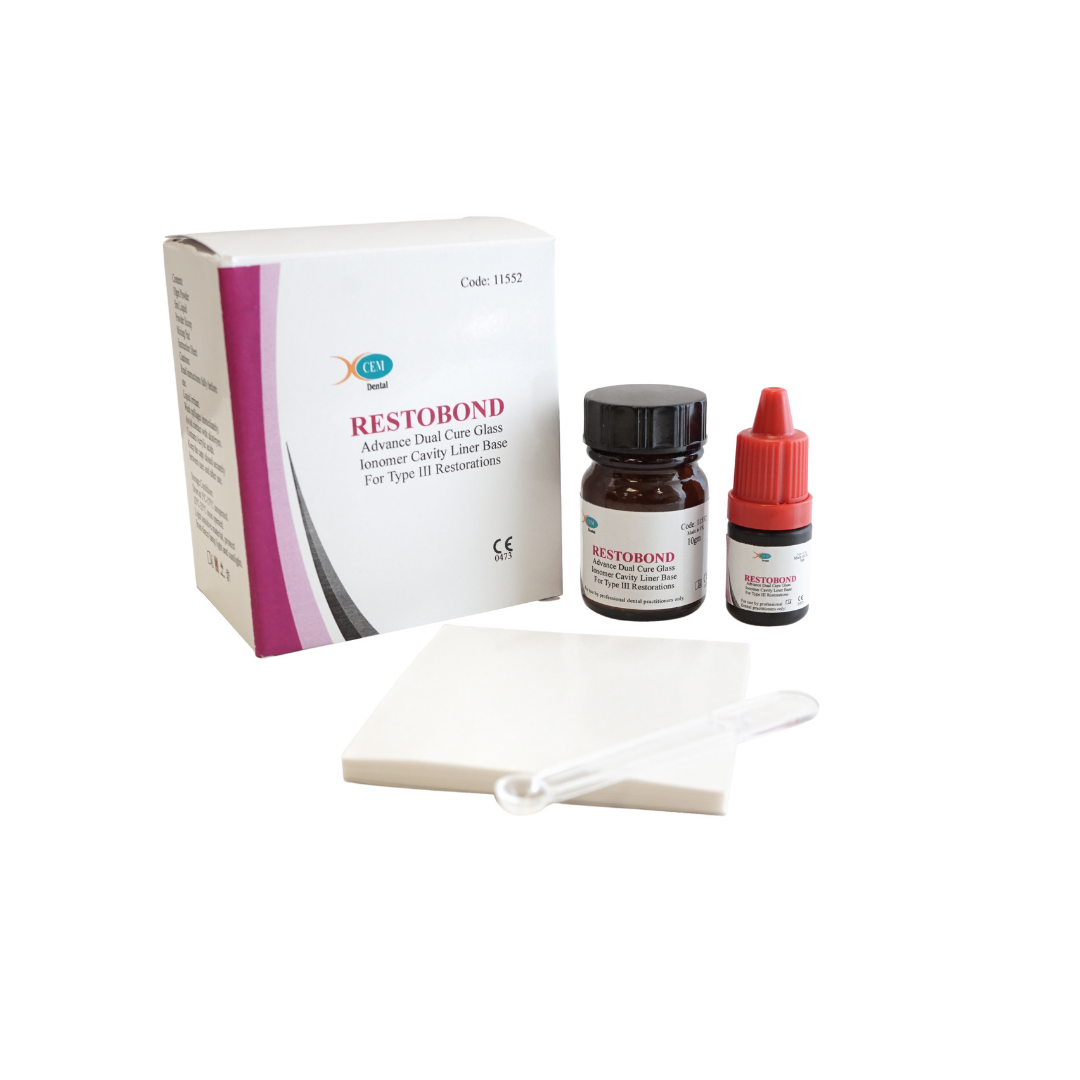
Restobond 10g Powder 5ml Liquid
Visible light cure powder/liquid glass ionomer
It is a visible light cure powder/ liquid glass ionomer preparation. The powder is essentially the traditional fluoroalumino silicate glass frit but especially treated to impart radio-opacity. The liquid contains Polyalkenoic acid and a mixture of other acrylates and light sensitive catalyst.
Visible light cure type III radio-opaque lining and basing of dental cavities glass ionomer.
RESTOBOND is a visible light cured powder/liquid glass ionomer preparation. The power is essentially the traditional fluoroalumino silicate glass frit but especially treated to impart radio-opacity. As it is light sensitive and moisture sensitive, it needs to be stored in tightly sealed bottles away from direct light. The liquid contains Polyalkenoic acid and a mixture of other acrylates light sensitive catalyst. When the power and liquid are mixed the glass ionomer reaction immediately commences with a steady but low level release of fluoride ions and the carboxyl group in the acid also give rise to the unique possibility of chemical bonding with tooth structure. The glass ionomer reaction in Gem Base has been prolonged so as to allow for ample opportunity to carry out multiple applications with ease and comfort.
Once in place the material can be commend-set (hardened) by exposure to visible light from standard polymerisation unit. Advantages of commend-set is extended working time coupled with sudden onset of optimal mechanical and physics properties a vital quality for liner/base materials which are to support condensed metal, ceramic op composite fillings.
CAVITY PREPARATION
All decay should be remove followed by through prophylaxis of operative area and drying (the use of rubber dam is recommended). The use of smear layer cleanser (e.g.Polyacrylic acid solution) or bonding agents (e.g. glass ionomer), but for large cavities, a retentive cavity may provide the extra confidence.
PULP PROTECTIONS
In very deep or large cavities and in case of pulp exposure. The use of Calcium Hydroxide liner is recommended. DENCARE pulp plus is recommended, whilst light cured Calcium Hydroxide liner should be place in the deepest part of the cavity or in a manner to seal and protect the exposure.
DOSING RATIO
Before use, insure both powder and liquid are at room temperature.
POWDER
Invert close powder bottle several times in order to fluff and loosen any compacted powder. Open bottle and remove powder by overfilling the power scoop and then using stainless steel cement spatula gently tap stem of scoop several times before levelling of the excess powder. DO NOT compress the excess powder, but scrap-off with the edge of spatula. Dispense two level scoops of powder per mix.
LIQUID
Dispense liquid by inverting the bottle until it is vertical and squeezing gently until one at a time is dispensed directly onto mixing pad. THREE DROPS per mix is recommended, but for extra fluid Mixes FOUR DROPS may be dispensed. In order to dispense consistent size drops each time, it is advisable to occasionally wipe spout of bottle tissue paper.
POWDER/LIQUID RATIO
Standard mix :-2 level scoops of powder: 3 drops liquid: 0.18gm powder: 0.09gm liquid.
Extra fluid mix :-2 level scoop of powder: 4 drops liquid: 0.18gm powder: 0/012gm liquid.
MIX
Using the stainless steel cement spatula, mix first scoop of powder INTO liquid, and not until all the powder from the first scoop has been wetted, should the second scoop be mixed in. Allow 15 to 20 seconds for the mixing, and then a further 15 to 20 seconds for the spatulation. The spatulation should be through vigorous to give a wet mix which is smooth lute able consistency and of a glossy appearance.
APPLICATION
Using a ball-end probe, or other suitable instrument, pick up some of wet mix spread onto floor of cavity. The application of material should be restricted to the dentine surface. At normal room condition (23° C, 50% RH), RESTOLUX L is working for up to 4 minutes. Higher temperature or direct light (e.g. strong sunlight) will shorten working time.
COMMEND SET
Exposing to light from a standard polymerisation light unit (50-70 watt power output at 400-500 mm) can harden RESTOBOND. It can be hardened immediately following satisfactory per 2.0mm maximum thickness. In situations where greater than 2.0mm layer is required, then RESTOBOND placement with subsequent curing must be performed in increments of 2.0mm thick layers.
CAVITY RESTORATION
Following the commend set of RESTOBOND L, the cavity can be restored by packing with composite or glass ionomer material. Alternatively, it is quite possible to finish with amalgam or metal restorative materials using a condenser.
CAVITY RESTORATION
Enamel if any RESTOBAND material has accidentally cured onto the enamel, then chip off, using a fine-ended probe. Carefully apply Phosphoic acid etch ant to area of enamel, which is to be covered with the filling material, and acid etches as per manufacturer instructions. The acid etching of the RESTOBOND materials or dentine is not advised.
DENTINE/ENAMEL ADHESIVE
The cure RESTOBOND, dentine and the acid etched enamel can all be treated with composite adhesive. Should the composite adhesive employ a dentine primer, and then the hardened RESTOBOND should be coated with primer as well. Otherwise, follow the manufacturer instructions for the composite adhesive, and then proceed to composite placement.
GLASS IONOMER RESTORATION
Polyacrylic acid cleanser. The use of Polyacrylic acid cleanser ( Dencare conditioner bond) is recommend as per manufacturer instructions. The RESTOBOND material should be treated with the cleanser in the same manner as the dentine enamel is treated.
Following the use of Polyacrylic acid cleanser the cavity can be filled with glass ionomer as per manufactures instructions.
STORAGE
For long term, refrigerated storage at 5°C to 12°C is recommended.
USE
If taken from refrigerated allow powder and liquid to reach room temperature of 21 to 24 C before use. As both powder and liquid are light and moisture sensitive, always replace caps tightly after dispensing the material. This will also help control acrylate vapour level in the work area.
PRECAUTIONS
This preparation contains an acrylic mixture. Avoid contact with skin and eyes, and unnecessary contact with oral mucosa. In case of accidental contact, flush with large quantities of water.
Acrylates very occasionally induce an allergic response in sensitive individuals. In order to minimize such risk, avoid excessive operator and patient exposure to material (particularly the uncured powder and liquid), and always remember to tightly close caps after use. Latex gloves do not offer 100% barrier to acrylate permeability.
INDICATIONS
Radio-opaque lining and basing of dental cavities subsequent to restoring with composites, glass ionomer, amalgam or metal fillings.
CONTRA INDICATIONS
Not to be used on people who are allergic to acrylates.
Not for direct pulp caping.
Not for placing over eugenolcontaining cavity lining compositesBestsellers
Sold out
Sold out